
The Rise of Cultural Homogenisation
Introduction
We live in a digital world. The majority of our time is spent engaging with some form of digital media: smartphones for global communication, laptops for entertainment, computers for work and study, even watches that monitor our sleep patterns, heart rates, and calories burned. We are constantly engulfed in the flames of a vast technological ecosystem, one that subtly moulds how we think, interact, and appreciate ourselves.
You can’t escape it either – unless you’re willing to forsake most forms of social connection, prospects for a conventional life, or opportunities for academic enrichment. Digital media, consequently, is not optional; it has become increasingly inevitable.
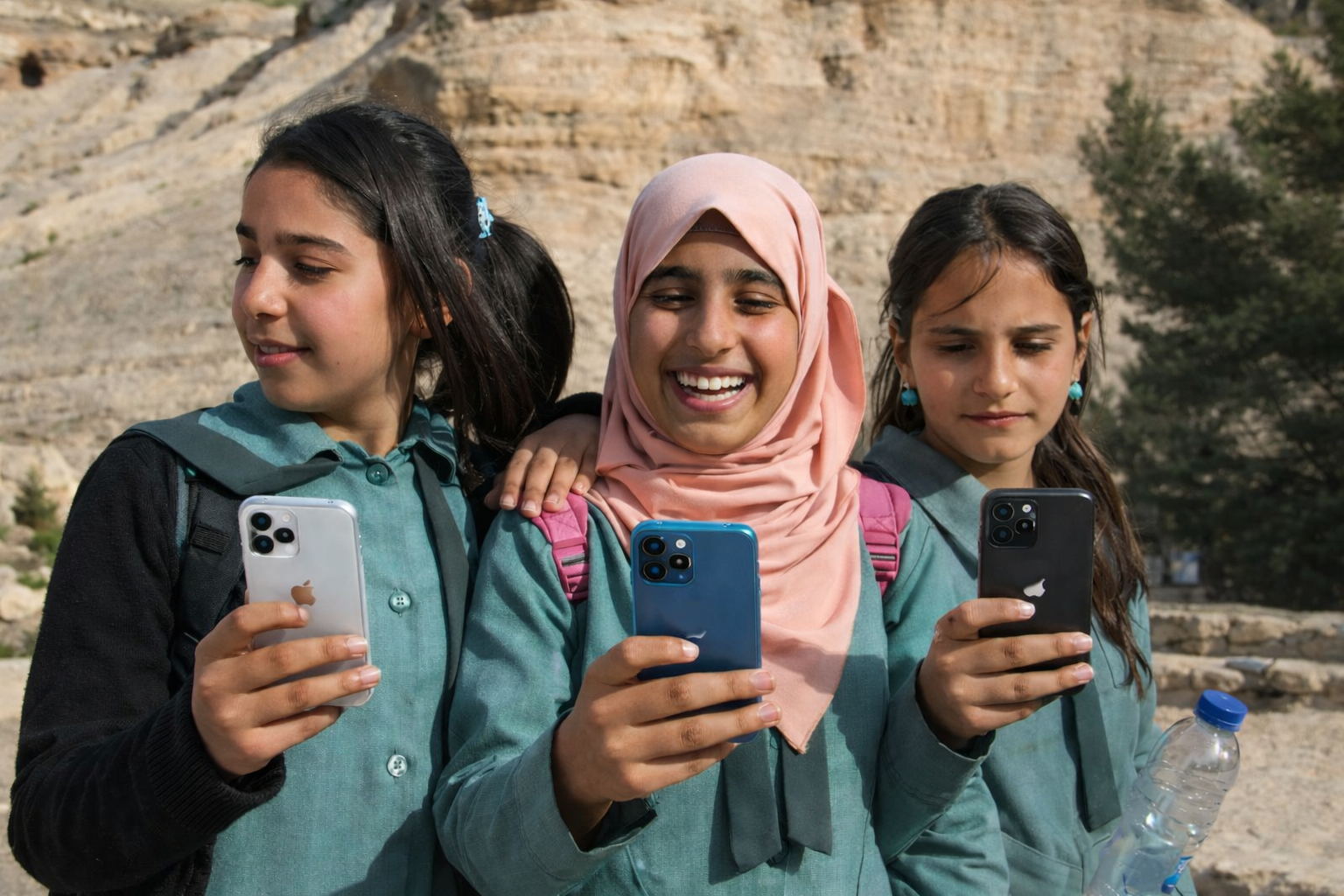
Imagine, for a moment, a young woman in Amman. Assuming she is equipped with the typical digital tools, her smartphone serves as an opening to foreign communities and cultures, where she interacts with and consumes international trends, idioms, and specific narratives that extend far beyond her existing cultural values. Throughout her digital consumption, the values and norms that form her individuality – local traditions, holy customs, and communal ethics – gradually become diluted and forgotten rather than carried forward.
These digital platforms are celebrated for their notable ability to connect individuals across borders. Yet amidst this digital framework, the critical question emerges: in an age of exceptional digital connectivity, to what extent are young Jordanians becoming dissociated from their cultural roots and identities?
Digital Spaces: New Cultural Arenas for Jordanian Youth
Any typical teenager in Jordan, or in the world for that matter, would advocate for the fundamental role social media plays in connecting peers. On a typical day, the average Jordanian teen would open platforms such as Snapchat (≈55%), and Instagram (≈60%) without fail. Even after a nationwide ban, an estimated 1 in 11 Jordanian teens (≈9%) continue to access TikTok through VPNs, highlighting the platform’s persistent grip and the extent to which usage resists regulatory control. This demonstrates the emergence of social media as an automated routine rather than a supportive tool. In fact, global studies show that adolescents spend an average of 4.8 hours per day on social media platforms, reinforcing patterns of habitual use rather than occasional engagement. This constant need for digital stimulation has become as standard and automated as brushing one’s teeth.
Consequently, digital media have slowly begun to augment and, in some spaces, replace traditional cultural settings like family reunions, community celebrations, or human interactions. While we cannot deny the significance many offline spaces hold, the stark contrast social media displays – offering immediate validation, visibility, and reward – enables us to realize the appeal that digital platforms present and why we, as a society, seem unable to resist this shift.
It is vital to acknowledge the role social media plays in forming an independent cultural forum. Rather than serving as a neutral platform for collaboration, social media adheres to its own rules, incentives, and norms. It has its own culture. Based on its own aesthetic, norms, and guidelines, social media’s cultural amalgam results in the spread of a shared or uniform identity across the majority of users. By consistently exposing themselves, many Jordanian teens don’t simply engage through online spaces; rather, they are subsumed by its unpredictable influence, gradually shaping their outlook on their cultural identity and sense of belonging.
The Digital Creation of Hybrid Cultures
As the digital world continues to expand, we can recognise the gradual shift in how we present our identity. Rather than being inherited and passed on, our identity is showcased, displayed, and available for public scrutiny. Specifically for Jordanian youth, digital media acts as a battleground of identity and cultural values – where local and international traditions, norms, and identities interact. This results in the formation of hybrid cultures, neither traditional enough for Jordanian society nor globalized enough for international audiences. This cultural shift is prominently displayed in the digital persona many young Jordanians take on.
We can notice this cultural blend through language. In many areas of Jordan, particularly Amman, we can recognize many English idioms, digital trends, or foreign expressions woven seamlessly into Arabic diction. Many view this semantic shift as a form of convenience and efficiency, seeing it as an inclusive act that encourages a more effective mode of communication. In addition to the dialect, we can recognize the effects of hybrid cultures through fashion styles, prominent music tastes, lifestyles, online trends, and many other aesthetic choices that subtly tailor globalized trends to a more local audience by adhering to customary social norms and expectations.
As we delve deeper, we can recognize the gradual influence on our behaviour and values. Traditional Jordanian values, for the most part, prioritize a collectivist approach, valuing communal assistance and cooperation. On the other hand, social media promotes an individualised approach, with visibility, recognition, and self-promotion being key pillars within the digital world. Surprisingly, this does not result in the complete rejection of Jordanian culture. Rather, the Jordanian youth selectively adopts globalized values while still preserving the core principles of traditional culture.
Additionally, it is vital to realise that this cultural hybridity often happens behind the scenes – without our realisation. Although some intentionally take on a persona that aims to bridge both cultures, it is mainly a passive process attributed to the consistent exposure to social media. The content that gains the most attention is promoted and prioritised, creating a subtle cue of what type of behaviour and principles are socially acceptable, modern, and appropriate. The passive absorption of such content results in the normalization of cultural blends, hindering our self-perception while refuting proper reflection.
The psychological impact of this cultural hybridity has caused much ambiguity among studies. While cultural blends certainly offer a sense of belonging and greater freedom of expression, it also creates a subtle, disconcerting effect by challenging the truth of one’s cultural allegiance. Instead of overriding culture entirely, social media gradually dilutes its significance, rendering it an act of performance – open to alterations, revisions, and enhancements.
The Battle Against Monotony: Trends & Algorithms
Although our formation of online identities seems to be governed by user autonomy and individual choice, in reality, it is subtly swayed and manipulated by unnoticed online frameworks. Algorithms regulate the type of content being perpetuated, which perspectives are promoted, and which social norms gain acceptance. These algorithms are carefully aimed at valuing stimulation over inclusion and spread content that aligns with major global trends and norms.
You may notice recent viral online trends showcase this influence. No matter the category – fashion patterns, lifestyle preferences, dietary trends, or humorous idioms – such content disseminates across the globe, encouraging replication. To be acknowledged is to surrender, with conformity acting as a requirement for recognition. Many Jordanian youths view these circumstances as a confronting pressure – urging the adoption of such globalized trends under the pretence of acceptance, while they do not realise the gradual dilution of local values, traditions, and identity.
Rather than malice or harmful intentions, these smart algorithms are based mainly on logic, structure, and predictability. According to a recent study, smart algorithms prefer patterns, comfort, and widespread acceptance. They tend to overshadow local content that promotes familiar traditions and values. Consequently, this repeated exposure to consistent standards, ideas, and actions gradually hinders the user’s ability to distinguish what is “socially acceptable”.
This has raised many objections regarding autonomy and user choice. Although users do choose whom to follow and whom not to, the content presented to them is constantly shaped by smart algorithmic suggestions, recommendations, and featured content. This selected content exposure, over time, begins to feel natural, authentic, and maybe even effortless. But does this hinder our ability to differentiate between content that we select and content that is imposed upon us? – I certainly fear so.
Rather than overt constraints and limits, homogenisation is established through a creeping familiarity. Uniformity acts as an enigmatic veil of safety, comfort, and mutual acceptance. The dangers of such uniformity do not lie in immediate cultural destruction, but in gradual sameness, where our cultural nuances continuously blend and disturbingly become an afterthought.
Cultural Sameness: The Nuances Behind Homogenisation
Many arguments against cultural homogenisation are typically based on the prediction that it follows a linear trajectory – resulting in an increasing sameness while diminishing individuality. However, in the Jordanian community, homogenisation doesn’t seem to emerge as a loss of values or identity. Many principles are still heavily rooted in local society, ranging from languages, beliefs, civic pride, and a strong sense of national unity. Initially, our exterior undergoes a noticeable change: our fashion sense, the way we joke, how we conduct ourselves online, and the way we communicate through digital forums all gradually shift.
Nevertheless, our uniformity is irrefutable. Youth around the world, although originating from various cultural backgrounds, have all begun to adopt similar tastes, references, appearances, and adhere to similar digital identities. You may recognize this union and conclude that cultural divisions have reduced. Nonetheless, this external unification certainly does not immediately signify the destruction of cultural individuality.
The disturbing question still remains: Does this superficial uniformity later develop and hinder our core cultural principles? – Not necessarily. Even if social media does promote a self-focused, individualistic approach, this does not aim to overpower local values or cultural identities. In fact, many Jordanians may perform an internationally tailored identity on digital media while still maintaining their local cultural expectations offline.
Realising this, we can recognize cultural homogenisation to act as a restraint rather than outright cultural obliteration. Cultural identity itself is not being threatened; rather, it is the availability of spaces for free, unfiltered, and pure expressions of identity – acknowledging this dichotomy is fundamental. Essentially, viewing cultural homogenisation as an outright collapse in individuality grossly exaggerates the truth and diminishes the multi-layered complexity of the influence of digital media on cultural development and local identity.
However, young Jordanians do not passively bow down to such pressures to conform. Rather, their mediation of globalised trends under a local cultural framework certainly showcases a hopeful opposition – an underlying expression of identity that redefines the cultural fabric of the Jordanian future.
Final Remarks: Key Takeaways
All things considered, we can identify the irrefutable influence that social media plays in the creation of cultural blends within the Jordanian youth, altering the expression, performance, and manifestation of identity. Through constant exposure, semantic variations, and systemically promoted content, young Jordanians must navigate a cultural battleground against globalised norms and values. This cultural blend is neither intentional nor a consequence of unprecedented events; rather, it is the outcome of both intentional curation and the passive retention of digital values.
Even though the worries of cultural uniformity are certainly justifiable, the reality is far more multifaceted than assumed. External convergences, ranging from fashion styles, borrowed idioms, or similar online appearances, are not equivalent to deeply embedded local values (e.g., religious beliefs, social norms, communal expectations, etc.). Rather, this digital world mirrors the suppression of culture, a realignment that aims to hide cultural divisions instead of destroying them entirely.
The remaining query is not regarding the capability of social spaces in reforming identities – it’s irrefutable in its ability – rather, the question is: How may the Jordanian youth circumnavigate this overt transformation? – I suppose they may continue by actively deciding their stance between international acceptance and local values through selective integration. Nevertheless, our digital world is not a complete danger to our identity, but a platform on which cultural perseverance, innovation, and self-autonomy thrive.
As you reflect on the balance we choose to take, I leave you with a simple prompt: Do you wish to adapt… or to persevere?
Disclaimer: The thumbnail used in this publication was generated using artificial intelligence and does not depict real people, events, or locations.