
Jordan’s Elderly Healthcare in Global Context
Introduction
As people age, they rely more and more on healthcare. Their bodies are no longer as capable or as powerful as they once were when they were younger. Their immune system can’t fight off diseases as well; their muscles grow weaker and more tired, and their bones also weaken. This is why healthcare for the elderly has become a pressing issue across all healthcare systems and communities. Governments must think of creative ways to improve the quality and accessibility of healthcare, while keeping it affordable.
Jordan, like many countries today, has experienced an increase in its elderly population due to major improvements in life expectancy and quality of life. This improvement poses a challenge for the nation's healthcare system. This article will explore how elderly healthcare in Jordan differs from other systems around the world and evaluate the benefits and limitations of healthcare services available to the elderly in the country compared to international standards.
Accessibility and Affordability of Elderly Healthcare in Jordan Compared to Other Countries
Accessibility and affordability are central factors in assessing a country's healthcare system. In Jordan, healthcare is divided into two sectors: public providers serving under the Ministry of Health and military hospitals affiliated with the Royal Medical Services, and the private sector. Public healthcare in Jordan is usually very affordable due to subsidies and other programs that help. The subsidies in Jordan are government-allocated public funding provided to the Ministry Of Health and other public healthcare providers to partially cover the cost of consultations, hospital admissions, surgeries, medications, and other health-related procedures. This makes the patient pay a reduced fee compared to the full market price, making healthcare more affordable. Elderly individuals who are classified as low-income or those who need social assistance may qualify for higher subsidies, and therefore a higher price reduction in fees. While this helps make healthcare in Jordan more affordable, it is still limited by level, as the level of subsidy is dependent on the type of insurance coverage a person holds, and whether they are treated in a public or private facility.
The second way that Jordan addresses affordability of healthcare is through the Civil Insurance Program (CIP), which is one of the main public health insurance schemes in Jordan, and operates under the authority of the Ministry of Health. It provides government-funded health coverage to eligible citizens, including civil servants, a portion of retirees and their dependents. For the elderly, individuals who previously worked in the public sector are covered through this program after retirement. In this program, the government subsidizes the majority of treatment expenses. However, this coverage may not extend to specialized elderly treatment, advanced procedures, private hospitals, or extensive home-care support. As a result, while the Civil Insurance Program improves affordability for many elderly Jordanians, it is not a comprehensive long-term solution like those that already exist in high-income countries with dedicated elderly insurance systems.
From an accessibility standpoint, access to consistent or urgent healthcare is a major issue. This is because the public sector in Jordan is often overcrowded, with long wait times and a shortage of specialized services, which can be a massive issue for elderly patients with chronic conditions such as diabetes, hypertension, or cardiovascular diseases that would need immediate healthcare. And while private hospitals do offer more specialized equipment, with little to no waiting times, the costs are significantly higher, making it unaffordable for low-income individuals without insurance.
Geographic inequality is also a pressing issue, as most healthcare facilities are concentrated in major urban centers and cities like Amman or Irbid. Meanwhile rural regions lack nearby advanced services, making elderly patients travel long distances, which can be physically and financially draining.
Compare this to high-income countries such as Germany, Sweden, and Japan, which are all countries that provide universal healthcare coverage to all areas, with long-term insurance systems for the elderly. Also, this could be compared to some middle-income countries such as Brazil or Thailand, which offer public healthcare systems with varying levels of elderly coverage, though funding limitations can still create a service gap. Therefore, while Jordan’s healthcare performs well compared to its region, it still falls short of the high-income countries when it comes to universal coverage, rural service distribution, and long-term affordability.
Types of Healthcare Services in Jordan Compared to Global Systems
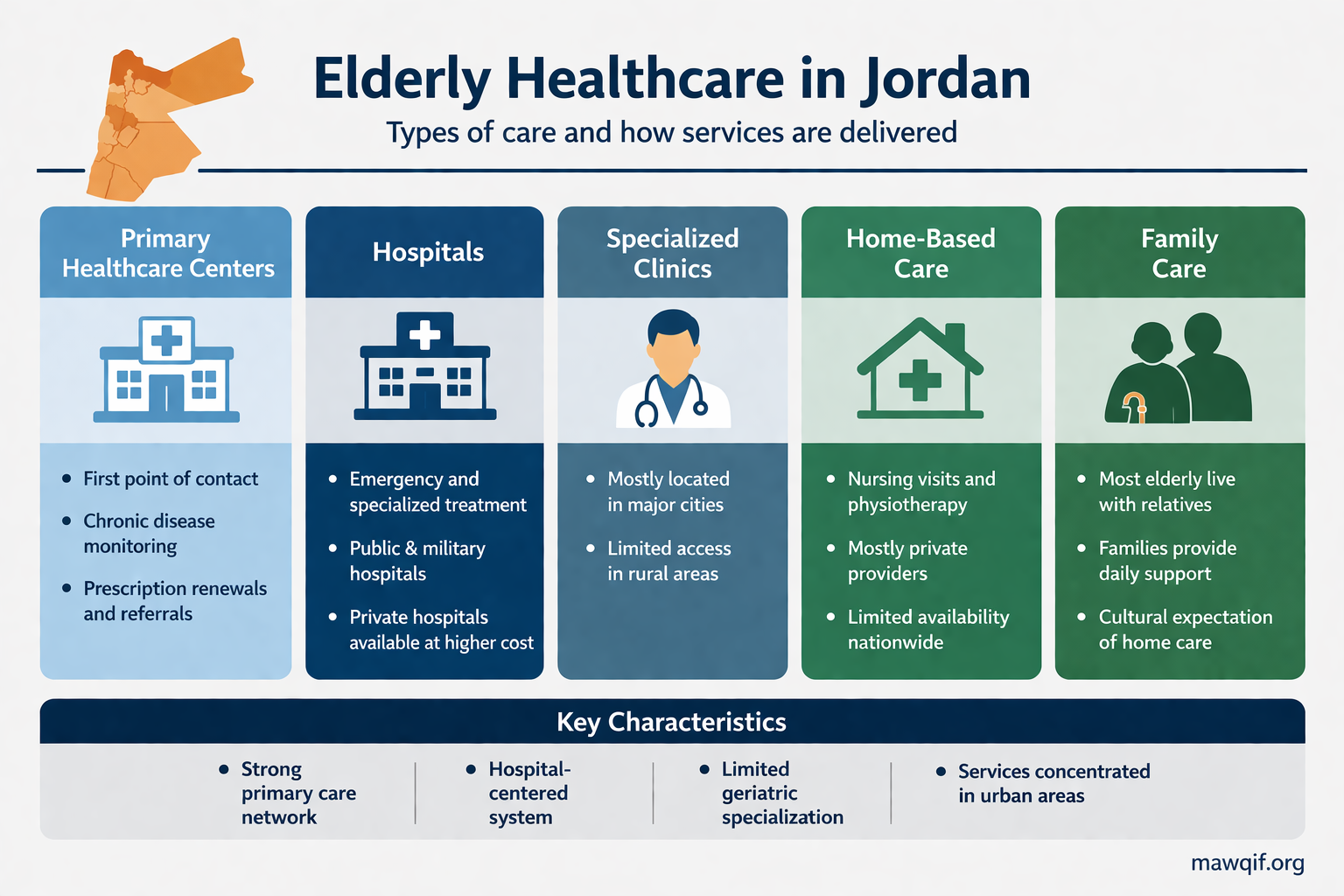
In Jordan, elderly healthcare services are usually delivered through the general healthcare system, rather than a specialized geriatric network. An elderly man in Jordan would usually start his care journey at primary healthcare centers. These centers are widely distributed across the country and serve as the first point of contact for routine medical needs. They provide blood pressure monitoring, blood glucose management, prescription renewals, specialist referrals, and vaccinations. These centers play a primary role in reducing cardiovascular disease, diabetes, and hypertension in Jordan’s population, which are all common issues that the elderly face.
If the patient's situation gets worse, the elderly patient will be referred to a public hospital under the Ministry of Health, or military hospitals with the Royal Medical Services, or in some extreme cases, private hospitals. These institutions offer emergency care, surgical procedures, diagnostic imaging, and other services. In major urban areas such as Amman or Irbid, specialized clinics offer more focused treatment, but again, with a higher fee.
Home healthcare services are also available in Jordan through certain private providers and charitable organizations. These services include nursing visits, physiotherapy sessions, and limited assistance. However, compared to higher-income countries, home healthcare in Jordan is still significantly underdeveloped. Availability is also a major hurdle to overcome, since availability is concentrated in larger cities, and the elderly living in rural areas may face issues when seeking home health care.
Additionally, Jordan faces a lack of dedicated geriatric hospitals and wards that are designed to address the complex needs of older adults. While geriatric specialists do exist, they are not deeply institutionalized as in some developed healthcare systems. This can be attributed to the Jordanian culture that emphasizes family responsibility for elderly care, meaning that many older adults live with relatives who provide support instead of institutional care. While this cultural expectation strengthens family bonds and lowers anxiety and loneliness, it places significant pressure on families when elderly individuals require intensive medical care.
While palliative care in Jordan has improved over the last couple of years, it still remains underdeveloped in some key areas. Globally, many high-income countries have established more specialized and integrated systems, tailored to aid aging populations. Countries such as Japan, Germany, and Sweden, for example, offer a comprehensive geriatric assessment conducted by specialized teams. These exams are not limited to physical health, but also test cognitive function, well-being, mobility, and social life. Rehabilitation programs are also much more widespread to help patients recover from strokes, fractures, and surgeries. Also, in many of these countries, a structured home-based care program allows elderly individuals to receive medical and supportive services in their own homes, promoting independence. Furthermore, more developed healthcare systems include integrated social support programs that ensure coordination between hospitals, community services, mental health providers, and caregiver support networks. These high-income countries also stress the importance of preventative measures against dementia and chronic diseases, which results in elderly care in these countries to be multidisciplinary, preventative, and sustainable.
In comparison, Jordan provides essential and often effective medical services, particularly in primary and acute hospital care. However, Jordan's system remains more hospital-centered rather than focused on specialized healthcare like the ones present in more developed countries. Therefore, while Jordan has a solid healthcare foundation and a strong family-based support tradition, its elderly healthcare services are less comprehensive and less specialized when measured against global leaders in geriatric care.
Benefits and Limitations of the Jordanian Healthcare System
Elderly healthcare in Jordan has many benefits and limitations. First, Jordan has a large number of accessible healthcare facilities in urban areas, with high affordability and distribution. As stated above, this is due to the provided programs and subsidies. However, this accessibility is limited in two ways.
First, rural areas. The healthcare systems in Jordan are mainly concentrated in and around urban areas like Amman and Zarqa, leading to geographic inequality, as those people living in rural areas will have less access to these healthcare services. This is accentuated in the elderly, as traveling long distances can have a great physical or financial toll on them.
Second, Jordan cultural tradition of family-based care. While this increases the strength of familial bonds and decreases feelings of isolation, it can also lead to health problems when it comes to professional healthcare. This is because people will often keep their elderly home and try to treat them by themselves, even when they are facing serious health problems like diabetes or hypertension that will require professional supervision.
Another major limitation of the Jordanian healthcare system is the lack of specialized geriatric systems. This is because while Jordan has an abundance of accessible and affordable general healthcare, it lacks in sectors that are specific to the elderly. Other high-income countries like Japan or Germany, have a very well-structured and sophisticated geriatric healthcare system and sustainable insurance, that helps increase life expectancy.
All in all, Jordan has a very strong foundation for a strong healthcare system due to the accessibility and affordability of these healthcare systems, but it lacks in some departments, like specialized elderly care, ignorance of serious illnesses, and lack of accessibility in rural areas.
Global Context: Where Jordan Stands
When placed within a global context, Jordan’s elderly healthcare system reflects the characteristics of a middle-income country, balancing limited resources with increasing demographic pressures due to the increase in the aging population. In contrast, several high-income countries have developed advanced, sophisticated, and highly structured elderly care systems. For example, Japan is internationally known for its comprehensive long-term healthcare insurance system, which provides elderly citizens with access to home care, community services, and institutional care regardless of income level. Similarly, Nordic countries such as Sweden and Denmark offer universal healthcare combined with strong social welfare systems that integrate medical treatment, social support, and mental health services for older adults. Germany also stands out for its public long-term healthcare insurance and structured home-care programs, which reduce the burden on families and ensure consistency of care.
In comparison, Jordan lacks many of these formal mechanisms, particularly sustainable healthcare insurance and integrated social-health systems. However, Jordan’s challenges are not unique. Many Middle Eastern and African countries face similar dilemmas, including limited public funding, growing elderly populations, and reliance on family caregiving rather than professional care. In these regions, elderly healthcare systems often prioritize acute and primary care while struggling to expand specialized services for aging populations. Jordan performs relatively well within its regional context due to its stable healthcare infrastructure and relatively high medical standards, yet it falls behind global leaders in elderly care specialization, preventive programs, and long-term support systems. This comparison highlights Jordan’s middle position globally, stronger than many low-income systems, but less developed than the most advanced elderly healthcare models.
Conclusion
In conclusion, healthcare for the elderly in Jordan shows a mixed level of development compared to healthcare systems around the world. The country succeeds in providing accessible and affordable basic healthcare services through its public health infrastructure, ensuring that many elderly individuals can receive the necessary medical treatment. Strong family-based support systems play an important role in maintaining elderly well-being, offering daily care and emotional stability that reduces dependence on institutional services.
However, Jordan faces clear limitations in access to specialized geriatric care, long-term residential care, rehabilitation services, and sustainable insurance systems for aging-related needs. These gaps become more prominent when Jordan is compared to countries with advanced elderly healthcare systems, where multidisciplinary care, preventative programs, and integrated health and social services are the norm.