
Politics
How Does Social Media Shape Young Jordanians’ Political Opinions?
A single post can change how a conflict is understood. But who shapes the stories young Jordanians see, and which sources do they trust? This article explores how TikTok, Instagram and X influence their views on regional conflicts, the West’s role in the region, and the credibility of influencers compared with traditional news organisations.
Introduction
Imagine getting your political information from social media, whether through short videos, live broadcasts or political commentary. That’s the reality of many young adults currently living in this increasingly digitised society. Social media provides a platform through which political narratives, opinions and perspectives are shared and discussed. An analysis of the 2024–2025 Arab Opinion Index found that, on average across the countries surveyed, 71.5% of respondents agreed or strongly agreed that much of what is published on social media is false and potentially misleading (Arab Opinion Index, 2024–2025). This raises concerns about how false or exaggerated information affects the political perceptions of young Jordanians, specifically on regional conflicts.
How do young Jordanians use TikTok, Instagram, and X to access political information about regional conflicts in the MENA region?
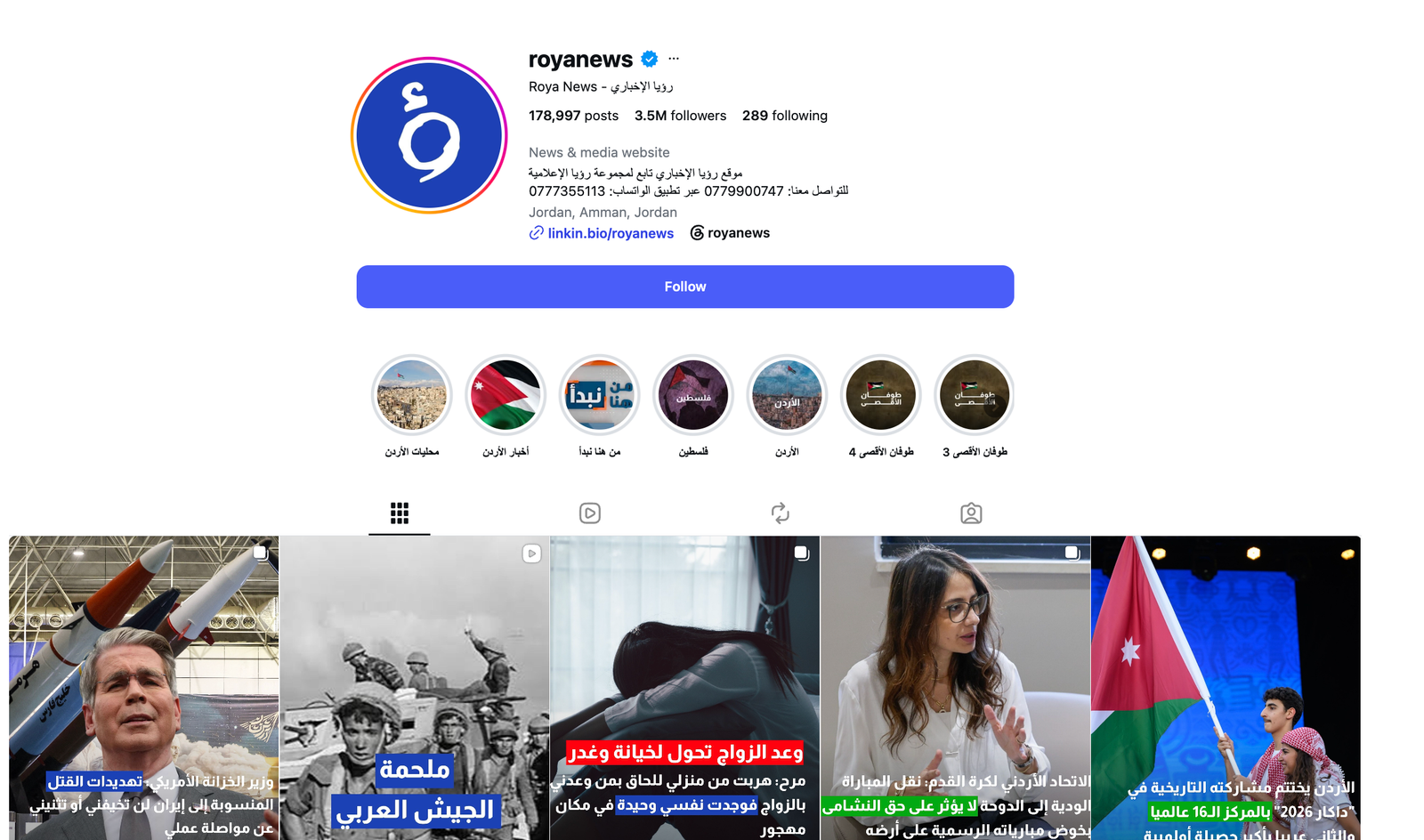
Social media is a major news source for young adults in Jordan. In a 2023 survey, 71% of Jordanians aged 18–35 identified social media as the source from which they most frequently obtained news (IRI, 2023, p. 93). Young adults can use Instagram, for example, Roya News’ account, to quickly update themselves on unfolding international crises through stories, content shared by friends, and reels. Additionally, they can use X for live updates and public debates that can shape their beliefs and ideals on a certain political issue. Lastly, they can use TikTok, where accessible, as TikTok’s short videos and personal accounts can be influential through its algorithm-recommended content based on users’ interests, potentially making young Jordanians more likely to engage with and become invested in the political issue they encounter.
The use of graphic images and eyewitness accounts on social media can attract young audiences to engage with the post and the political information it contains, sparking an interest amongst young Jordanians.
How does exposure to political content on TikTok, Instagram, and X shape young Jordanians’ perception of the West’s role in Middle Eastern affairs?
Due to social media’s ability to reach a vast number of people worldwide and share personal stories and accounts across the globe, young Jordanians are able to access and discover international political issues. As a result, they can become more politically aware of international issues and different perspectives; however, this also means they can be exposed to Western views on politics. A study of US television news analysed more than 600 sources across more than 200 stories about international events and found that Western sources appeared significantly more than non-Western sources (Oh, Banjo & Jennings, 2022). However, this study did not examine social media or Jordanian audiences. Selective footage, misinformation, and biased commentary could distort perceptions of certain issues, like the Palestinian–Israeli conflict. Nevertheless, this does not automatically mean that people directly assume the information they see is true; instead, they can confirm their information by doing further research on the topic. On the other hand, when certain political content is excessively repeated, especially from an influential creator, or presented through an emotionally engaging video, the argument can become more convincing. This suggests that social media can potentially shape perceptions of the West through using specific wording and visual details.
What factors influence young Jordanians’ trust in political information shared by social media influencers compared with traditional news organizations?
Social media provides a space for personal connection between the viewer and the creator. Because of this capability, it can increase the perceived authenticity and approachability of the influencer, encouraging more trust in the political information that is being presented to the viewer. In addition, owing to the relatable and personal content that social media produces, it creates a sense of familiarity that can increase the likelihood of viewers trusting the influencer’s political opinion and accepting their interpretations of current events. However, established news organisations’ reputation and professional standards can also encourage viewers to believe them. This is also because of the professional writers and fact-checking processes they may have, which can increase confidence in the news outlet.
Nonetheless, with both influencers and established news outlets, trust can be swayed by political bias and personal opinions, as viewers may be more likely to believe information that lines up with their existing beliefs and opinions, regardless of the accuracy or credibility of the source. This is demonstrated in a 2024 Stanford-led study of US adults that found that political alignment influenced participants’ belief in and intention to share political headlines more than the headlines’ actual truth (Schwalbe et al., 2024). This suggests that trust is not solely dependent on the source’s credibility or reliability, but also on the audience’s personal beliefs and their eagerness to reflect on different perspectives.
Social media gives young Jordanians easy access to news about regional conflicts, but access alone does not guarantee reliable information. Comparing sources, questioning misleading content, and considering different perspectives can help young people form more informed political opinions. A thirty-second video may introduce an issue, but understanding it requires looking beyond the screen.
Article Thumbnail: Two people look at their mobile phones while walking, with Amman, Jordan, in the background.
Bibliography
https://ojs.acrps.ai/index.php/almuntaqa/en/article/view/issue019-art09/html
https://www.iri.org/wp-content/uploads/2023/10/Jordan-State-of-Democracy-2023.pdf
https://ijoc.org/index.php/ijoc/article/view/18835
https://news.stanford.edu/stories/2024/10/new-study-shows-that-partisanship-trumps-truth
https://www.arabbarometer.org/wp-content/uploads/ABVIII_Jordan_Report-Public-Opinions-EN-1.pdf
Continue Reading
What Comparing Palestinian and Native American Land Claims Reveals
A comparative examination of Palestinian and Native American displacement reveals recurring patterns of land control, forced migration, and external political authority. By tracing historical policies and their lasting…
The Rise of Jordanian Businesswomen Combating Poverty Through Creativity
Entrepreneurship in Jordan is increasingly driven by women and youth who are transforming creativity into economic opportunity. Through competitions, training programs, and microfinance support, female entrepreneurs are building…
When the Sirens Became Routine: How War Reshaped Daily Life in Jordan
The Iran-Israel conflict did not stay beyond Jordan’s borders. From missile sirens interrupting classrooms to growing public desensitization toward danger, this article explores how weeks of regional escalation…